Upside-Down Car Loan Trade-In Options in Ellisville, MO
Trade-in worth less than you owe in Ellisville? Here's how negative equity, Missouri's sales tax credit, and dealer disclosure rules actually work.
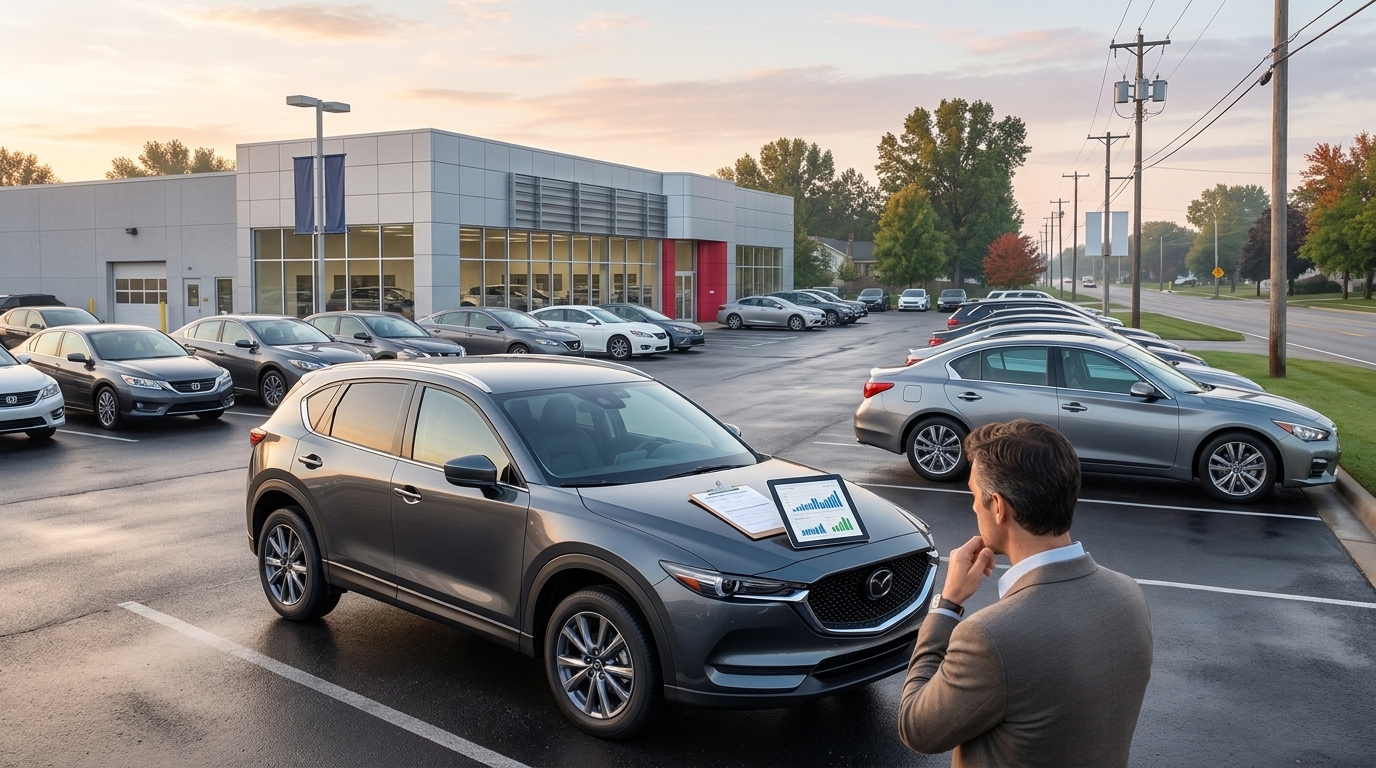
If your car's trade-in value is less than your loan payoff in Ellisville, MO, you have four realistic options: roll the negative equity into a new loan (disclosed as amount financed under Missouri law), pay the shortfall in cash at signing, delay the trade until you build equity, or sell privately for more than a dealer will offer. Missouri's sales tax trade-in credit under § 144.025 RSMo applies to the actual trade-in value only — not the payoff — so rolling negative equity does not shrink your tax bill.
What does it mean to be upside-down on a car loan in Missouri?
Being upside-down (or having negative equity) means the payoff balance on your current auto loan is higher than what the vehicle is actually worth as a trade-in. In Missouri, this gap doesn't disappear when you trade — it either gets paid in cash, rolled into your new financing, or absorbed by gap insurance in a total-loss scenario. It's a math problem, not a dead end.
Long loan terms, minimal down payments, and rapid first-year depreciation are the usual culprits. Buyers who financed 72- or 84-month terms often stay underwater for the first two to three years. At Bommarito Nissan Ballwin in the Ballwin–Ellisville corridor along Manchester Road, the trade appraisal will show you exactly where you stand before any paperwork gets drafted.
What are your options when your trade-in is less than your payoff?
You have four practical paths in Missouri: (1) roll the negative equity into the new vehicle loan, where it's disclosed as part of the amount financed; (2) pay the difference in cash at signing; (3) postpone the trade until the loan and value catch up; or (4) sell the vehicle privately to capture a higher price than wholesale trade value. Each has real tradeoffs on monthly payment, total interest, and future equity.
Option 1: Roll the negative equity into the new loan
Under Missouri's Motor Vehicle Time Sales Act (Chapter 365 RSMo) and federal Regulation Z, any payoff amount that exceeds your trade-in allowance must be itemized as an addition to the amount financed on your retail installment contract — not disguised as down payment. That means it's added to your new loan principal and you pay interest on it. This is the most common path, but it stretches how long you'll stay underwater on the next vehicle.
Option 2: Pay the shortfall in cash
Writing a check for the negative equity at signing keeps your new loan clean and starts the next vehicle closer to equity. It's the cheapest option over the life of the loan because you avoid financing the shortfall at your loan's APR.
Option 3: Wait it out
If your current vehicle still runs well, keeping it for another 6–18 months of principal reduction is often the smartest financial move. Ask a dealer for a written appraisal so you can track the gap over time.
Option 4: Sell privately
Private-party sale prices typically run higher than trade-in wholesale, which can eliminate or shrink the shortfall. The tradeoff: Missouri's 180-day rule under § 144.025 RSMo lets you still claim the sales tax credit on a separate sale, but only if the new vehicle is purchased within 180 days of that private sale. Miss the window and you lose the credit.
How does Missouri's trade-in sales tax credit work with negative equity?
Missouri's § 144.025 RSMo gives you a sales tax credit equal to the actual trade-in value of your surrendered vehicle — not the payoff. Negative equity is not added to the trade-in credit; it's treated as part of the taxable purchase price of the new vehicle. So if your trade appraises at $15,000 but you owe $18,000, your tax credit is based on $15,000, and the $3,000 shortfall gets rolled into the amount financed and taxed as part of the new purchase.
This is different from states that tax the full price with no trade credit. Missouri buyers still benefit from the offset — just not on the underwater portion.
| Scenario | Trade Value | Payoff | MO Sales Tax Credit Basis | Rolled Into New Loan |
|---|---|---|---|---|
| Positive equity | $18,000 | $15,000 | $18,000 | $0 (equity applied) |
| Break-even | $16,000 | $16,000 | $16,000 | $0 |
| Negative equity | $15,000 | $18,000 | $15,000 | $3,000 |
How is negative equity disclosed on a Missouri retail installment contract?
Under §§ 365.070–365.080 RSMo and federal Regulation Z (12 C.F.R. Part 1026), the negative equity amount must be itemized as an addition to the amount financed on your contract, and the down payment line must reflect only actual equity you contributed. The contract must show the cash sale price, trade-in description and value, the payoff of the prior lien, down payment, unpaid balance, finance charge, APR, total of payments, and payment schedule.
A dealer cannot legally list negative equity as "down payment" or bury it inside an inflated trade allowance. Deferred down payments (pick-up payments) must be separately disclosed with the specific amount and due date of each installment. Misrepresenting any of this may violate the Missouri Merchandising Practices Act (§ 407.020 RSMo) and TILA — enforceable by the Missouri Attorney General, the Division of Finance, and consumers directly under 15 U.S.C. § 1640.
What about gap insurance when you're underwater?
Gap insurance covers the difference between what your insurer pays for a totaled vehicle and what you still owe on the loan. When you roll negative equity into a new loan, the gap between insured value and loan balance grows — making gap coverage more important, not less. Gap policies may not cover the full loan balance on heavily-underwater loans, so a residual balance could remain even with gap in place. Ask specifically what percentage of the amount financed your policy will cover before signing.
How should Ellisville, MO buyers approach a negative-equity trade?
Get three numbers in writing before you commit: (1) your exact 10-day payoff from your current lender, (2) the dealer's written trade appraisal, and (3) an itemized amount financed on any proposed new contract showing how negative equity is disclosed. In the West County market — from Ellisville out to Wildwood and Chesterfield — most franchise dealers, including Bommarito Nissan Ballwin, can pull payoff quotes and run this math the same day.
Bommarito Nissan Ballwin is a franchise dealer in the West County corridor — useful when your deal involves a payoff shortfall that needs to be walked through line by line.
Frequently asked questions
Can a Missouri dealer legally roll negative equity into a new car loan?
Yes. Rolling negative equity into a new vehicle loan is legal in Missouri, provided the amount is itemized as an addition to the amount financed on the retail installment contract under §§ 365.070–365.080 RSMo and federal Regulation Z. The negative equity cannot be misrepresented as down payment, and the disclosed APR, amount financed, and total of payments must accurately reflect it.
Do I still get a Missouri sales tax credit if my trade is underwater?
Yes, but only on the actual trade-in value — not the payoff. Under § 144.025 RSMo, the sales tax credit equals the difference between the new vehicle's purchase price and the actual value of the trade. The negative equity portion is added to the taxable purchase price of the new vehicle, so you don't lose the credit entirely, just the portion attributable to what you owe above value.
Is it better to sell my car privately if I owe more than it's worth?
Often yes. Private-party prices typically exceed dealer trade-in offers, which can close or eliminate the negative-equity gap. Missouri's 180-day rule under § 144.025 RSMo lets you still apply the sale as a trade-in credit for sales tax purposes — but only if you purchase the replacement vehicle within 180 days of the separate sale. Beyond 180 days, the credit is generally lost.
What happens to negative equity if my new car is totaled?
Your primary auto insurance pays the actual cash value of the totaled vehicle, which may be less than your loan balance because rolled-in negative equity inflated the loan. Gap insurance covers that shortfall, though policies may not cover the full balance on a heavily-underwater loan. Confirm the cap and exclusions in your gap policy before assuming full protection.
Can a dealer hide negative equity in the down payment line?
No. Under § 365.070 RSMo and Regulation Z, the down payment disclosure must reflect only actual equity the buyer contributed. Negative equity from a trade-in payoff must be separately itemized as an addition to the amount financed. Misclassification may violate the Missouri Merchandising Practices Act (§ 407.020 RSMo) and TILA, and is enforceable by the Missouri Attorney General, the Division of Finance, and private consumer lawsuits under 15 U.S.C. § 1640.
How long does it typically take to get out from being upside-down?
It depends on original loan term, down payment, and depreciation curve. A vehicle financed for 72 or 84 months with minimal down can stay underwater for a significant portion of the loan term. Making extra principal payments, choosing shorter loan terms, and putting real money down at signing all shorten the underwater period. A written appraisal every six months lets you track the crossover point.
Should I refinance my current loan instead of trading in?
Refinancing can lower your APR and accelerate principal reduction without triggering a new taxable purchase or resetting the underwater cycle. It's usually the right first move if your current vehicle meets your needs and your credit has improved since the original loan. Trading only makes sense if the vehicle no longer fits, in which case running the numbers with a dealer on both scenarios is worthwhile.
The bottom line for Ellisville buyers
Negative equity is a structural math problem with four legitimate solutions in Missouri — roll it, pay it, wait it out, or sell privately within the 180-day window. Whatever path you choose, insist on a written payoff quote, a written trade appraisal, and a fully itemized amount-financed disclosure before signing. Missouri's § 144.025 sales tax credit still helps, just not on the underwater portion.
Readers in Ellisville, MO who want this walked through professionally can reach Bommarito Nissan Ballwin at https://www.bommaritonissanballwin.com/ to get a payoff quote, trade appraisal, and a line-by-line look at how any negative equity would be disclosed on the contract.